

Introduction
The digital environment, particularly in SEO, is dynamic. With the dramatic shifts brought by Core Web Vitals, the unavoidable influence of AI overviews, and Google’s continuous algorithm updates, the way we approach structured data has fundamentally changed.
What was best practice just a few years ago might now be outdated and some can even harm your ranking. In 2026, the age of blindly implementing every available schema type is dangerous. The new rule is to understand the true value from each type of schema.
Google’s evolving guidelines, and the seen impact on search engine results pages (SERPs). This article will guide which schema types still deliver tangible benefits and which are a waste of important time and resources.
Understanding this difference is crucial for any SEO professional aiming to maintain relevance and drive performance in an increasingly advanced search environment.
Table of Contents
- Introduction
- What Schema Actually Impacts in 2026
- Types That Still Matter (High Impact)
- Types That Are a Waste of Time (Low Impact)
- How to Understand Value: A Practical Framework
- Implementation Checklist
- Case Study: Optimizing for “How-to” vs. “FAQ”
- Conclusion

What Schema Actually Impacts in 2026
The main purpose of schema markup remains the same: to provide search engines with detailed information about the meaning of content on a webpage.
However, how Google uses this information, and therefore what impact it has, has developed significantly. In 2026, the impact of schema can be categorized into a few critical areas:
1. Rich Results
Rich Results are perhaps the most visually obvious benefit of schema. These are the advanced listings on the SERP that go beyond the standard blue link and description, offering additional information like star ratings, images, prices, or step-by-step instructions.
In 2026, Google has become far more selective about which schema types qualify for rich results and under what conditions. The focus is on quality, accuracy, and genuine user utility.
If a schema type consistently hits a rich result for relevant queries, you can confidently understand its continued importance. Monitoring the “Rich results” section in Google Search Console is important to identify and troubleshoot eligibility.
2. Entity Understanding
Beyond surface-level interpretation, schema helps Google build a strong knowledge graph and understand entities (people, places, things, concepts) with greater accuracy.
By explicitly defining entities and their relationships on your pages, you assist Google in understanding terms and connecting your content to a broader relevant network.
This is not about directly ranking but about building context. A well-structured Organization schema, for example, helps Google understand your business as a recognized entity, contributing to a holistic view of your brand online.
This advanced understanding helps Google confidently understand the topical authority and relevance of your content in clear ways.
3. AI Overviews
The rise of AI Overviews (formerly AI SGE) has introduced another critical dimension to schema’s impact. AI Overviews, which shows information directly into the SERP, heavily rely on structured data to extract factual information and understand authoritative sources.
While Google’s AI models are incredibly sophisticated, providing accurate schema markup for key data points (e.g., product specifications, recipe ingredients, event dates) makes it significantly easier for the AI to accurately process and present your content.
Correctly implemented schema can increase the likelihood of your content being cited or summarized within an AI Overview, driving visibility even if users don’t click through to the original page. This emphasizes the need for accuracy and relevance to guidelines to be linked to a credible source.
4. Ranking Signals: Clearing Myths
It’s important to understand that schema markup is not a direct ranking factor. Google has consistently stated this, and it remains true in 2026 also. Implementing schema will not, by itself, contribute to bring your page from position 20 to position 1.
However, schema indirectly adds ranking by making Google’s understanding of your content. By helping Google better process your content’s meaning, purpose, and relevance, schema contributes to a more accurate match between user queries and your pages. This improved understanding can lead to better visibility, higher click-through rates (due to rich results), and ultimately, better rankings.
The true value is in enabling Google to understand the full context and quality of your content, which then allows its ranking algorithms to make more informed decisions.
Types That Still Matter (High Impact)
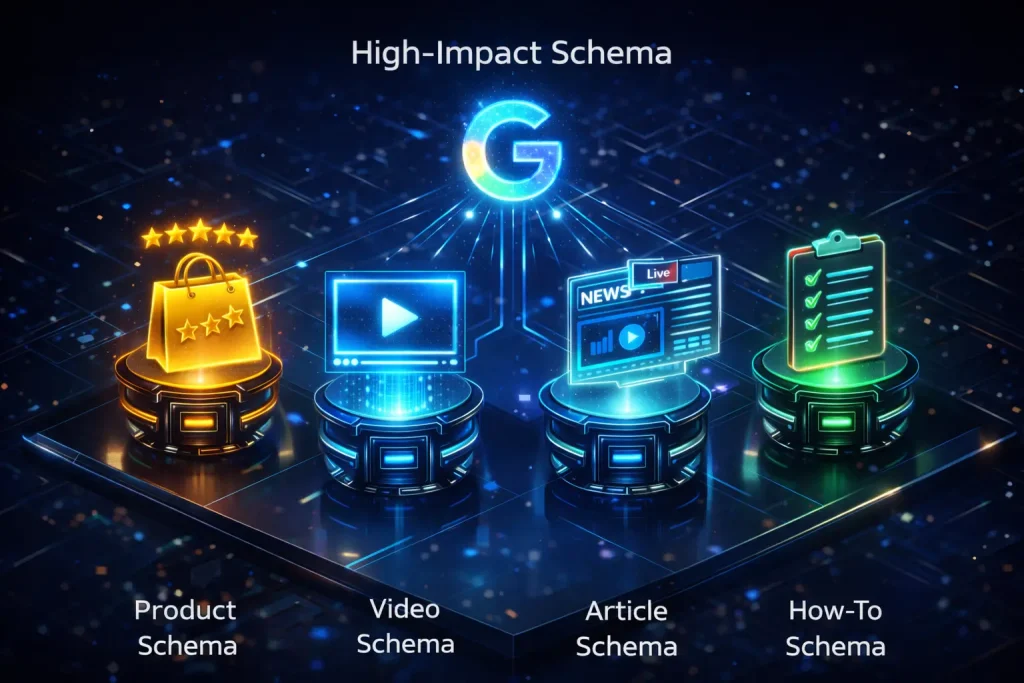
In 2026, a select group of schema types consistently proves their value, driving visibility, adding user experience, and contributing in search engine understanding. These are the high-impact types you should prefer.
1. Product Schema:
For any e-commerce site, a product schema is important. It allows you to accurately provide details such as pricing, availability (in-stock, out-of-stock), brand, unique identifiers (SKU, GTIN), and crucially, aggregateRating for review snippets.
These details often appear directly in rich results, significantly improving visibility and click-through rates for product listings.Without it, you’re losing valuable search visibility and potential customers every day
2. Article/NewsArticle:
Publishers, bloggers, and content creators benefit immensely from this. Article schema helps Google understand the nature of your content (news, blog post, scholarly article), its author, publication date, and headline.
This is important for appearing in Google News, Top Stories carousels, and generally signals the freshness and authority of your editorial content. It directly contributes to E-E-A-T by clearly adding expertise and showing authoritativeness.
3. Video Object:
With the continued growth of video content, Video Object schema is critical. It allows you to specify details like the video’s title, description, thumbnail URL, upload date, and duration.
This helps your videos qualify for rich results, appear in video carousels, and allows Google to better understand the content within the video itself, making it more visible across various search surfaces.
4. HowTo:
This schema type is very important for step-by-step guides, recipes, and instructional content. It divides content into different steps, often including images or videos for each.
HowTo schema frequently hits visually appealing rich results (often as carousels or collapsible elements), directly helping users in solving problems. Our case study later will further highlight its power.
Google actively looks to present actionable solutions, and HowTo markup directly helps this.
5. BreadcrumbList:
While it looks minor, BreadcrumbList schema makes navigation signals both for users and search engines. It clearly defines the hierarchical path of a page within a website, often replacing the URL in the SERP snippet with a more user-friendly breadcrumb path.
This improves user experience, reduces bounce rates, and helps Google understand the site structure and topical relationships between pages.
6. Organization/Person:
These schema types are the foundation for establishing E-E-A-T (Experience, Expertise, Authoritativeness, Trustworthiness). Organization schema defines your business, its official name, logo, contact information, and social profiles.
Person schema does the same for authors or important individuals, linking their expertise to the content they produce. Both help Google build a strong understanding of who is behind the content, adding credibility and authority signals across the web. They are crucial for brand recognition and showing authentic expertise.
Types That Are a Waste of Time (Low Impact)
Just as some schema types have importance, others have not, been decreased in value or are simply overused without proper justification. Allocating resources to these types in 2026 often produce small to no return.
1. FAQ :
This is perhaps the most significant recent casualty. In 2023, Google restricted FAQPage rich results, largely discouraging them for most sites outside of specific government and health websites. Many sites saw their FAQ rich results disappear overnight. Unless you operate in a highly specific, officially approved niche, implementing FAQPage schema is now largely a waste of time. Better to link your FAQs directly into your content or use HowTo schema if applicable. Trying to get value from this type of schema in 2026 would lead to disappointment.
2. Event (over-optimization):
While Event schema can be useful for true events (concerts, conferences, webinars), it’s often over-optimized for generic meetings or constantly recurring, low-value events. Google is increasingly reviewing Event schema.
If the event details aren’t frequently updated, the event isn’t publicly verifiable, or it’s simply a poorly hidden content piece, it will likely be ignored. Focus on verified events with clear start/end dates and locations.
3. Aggregate Rating (fake reviews):
While AggregateRating for products is vital, its misuse for non-product pages or through generating fake reviews is a significant risk. Google has advanced algorithms to detect review spam and fraudulent ratings.
Sites found using fake AggregateRating implementations risk manual penalties and complete removal of rich results. The effort to fake reviews is a waste of time and highly discouraged; focus on genuinely collecting and marking up true user reviews.
4. Job Posting:
This schema type is only relevant if you operate an actual job board or list job openings as a primary function of your site.
Using JobPosting schema for a single “careers” page that links to an external applicant tracking system, without strong, individual job listings on your site, provides little to no value. It won’t add to a deeper understanding if the content isn’t truly about individual jobs.
5. Generic “Article” on thin content:
Simply adding thin, low-value content (e.g., short, uninformative blog posts) in Article schema doesn’t magically make it high quality. Google’s algorithms are expert at understanding content depth and value independently of schema.
If your content lacks depth, Article schema won’t help it rank or gain rich results. It’s a waste of time to markup content that doesn’t have value. Focus on creating valuable content first.
How to Understand Value: A Practical Framework
Given the developing landscape, a strategic process to schema implementation is important. Here’s a practical framework to help you understand where schema can deliver the most impact.
1. Audit Current Schema:
Use tools like Google’s Schema Markup Validator and the “Rich results” reports within Google Search Console.
- Validator: Identifies syntax errors, missing required properties, and warnings.
- Search Console: Shows which rich results are eligible, invalid, or have warnings across your entire site. This helps to find outdated features or problems that affect many pages.
- Goal: Identify existing schema, list errors, and understand current rich result status.
2. Analyze SERP Features:
For your target keywords and topics, perform incognito searches.
- Observe: Do you see rich results (stars, images, carousels, “How-to” snippets) for competitor pages?
- Understand : If competitors are successfully showing rich results for a specific query, it’s a strong indicator that Google values that particular schema type for that intent. This signals an opportunity for your site to compete for similar improved visibility. Conversely, if no rich results appear, the ROI for schema might be lower for that keyword.
3. Match User Intent:
Schema should always serve the user.
- Question: Does the schema help answer the user’s query more effectively or provide important information directly in the SERP?
- Example: For “best smart widget reviews,” Product schema with aggregateRating directly addresses intent. For “how to fix a leaky faucet,” HowTo schema provides clear steps. If the schema doesn’t directly improve the user’s ability to complete a task or understand information, its value decreases. You should understand that schema which aligns with direct user needs will be preferred by search engines.
4. Test with JSON-LD:
JSON-LD is Google’s preferred format for structured data, offering flexibility and ease of implementation.
- Implementation: While using a new schema or modify existing ones you should always test it and make it live.
- Testing: Use Google’s Rich Results Test tool (part of Search Console) to validate your JSON-LD snippets. This tool shows how Google would use your schema and tells you if your page is eligible for any rich results.
- Monitoring: After using, closely monitor impressions, clicks, and CTR in Google Search Console for pages with newly implemented schema to record its performance impact.
Example Code: Product Schema
{
“@context”: “https://schema.org”,
“@type”: “Product”,
“name”: “Smart Widget 2026”,
“image”: “https://example.com/images/smart-widget-2026.jpg”,
“description”: “The Smart Widget 2026 is the latest in smart home technology, offering seamless integration and enhanced performance.”,
“sku”: “SW2026-001”,
“mpn”: “SW-V2.6”,
“brand”: {
“@type”: “Brand”,
“name”: “TechInnovate”
},
“offers”: {
“@type”: “Offer”,
“url”: “https://example.com/smart-widget-2026”,
“priceCurrency”: “USD”,
“price”: “199.99”,
“itemCondition”: “https://schema.org/NewCondition”,
“availability”: “https://schema.org/InStock”
},
“aggregateRating”: {
“@type”: “AggregateRating”,
“ratingValue”: “4.8”,
“reviewCount”: “120”,
“bestRating”: “5”,
“worstRating”: “1”
},
“review”: [
{
“@type”: “Review”,
“reviewRating”: {
“@type”: “Rating”,
“ratingValue”: “5”
},
“author”: {
“@type”: “Person”,
“name”: “Alice Green”
},
“reviewBody”: “Absolutely love my new Smart Widget! Easy to set up and works flawlessly.”
}
]
}
This comprehensive Product schema provides Google with rich details, making it highly eligible for rich results, from star ratings and price to in-stock status.

If you aren’t comfortable writing JSON-LD code from scratch, AI assistants can handle the heavy lifting. We discuss how to use ChatGPT for structural SEO tasks in our article on top free AI SEO tools for small teams.”
Implementation Checklist
To ensure your schema strategy is effective and relevant with 2026 best practices, follow this checklist:
- Audit existing schema for errors using validator tools. Regularly run your site through the Schema Markup Validator and monitor Google Search Console’s “Rich results” reports to catch errors, warnings, and invalid items. Resolve these promptly.
- Prioritize high-impact types based on business model (e.g., Product for e-comm). Focus your efforts where they will give the greatest return. For content sites, Article and VideoObject are key; for services, Organization and LocalBusiness might be important.
- Remove low-value schema (e.g., FAQ). Don’t waste resources maintaining or implementing schema types that Google no longer supports or values. Clean up your code for better efficiency and to avoid possible penalties.
- Test rich results eligibility in Google Search Console. Before making schema live, use the Rich Results Test tool to ensure your markup is valid and eligible for the rich results you expect. This proactive step prevents use of faulty schema.
- Monitor impressions/clicks to infer ROI. After implementing a new schema, track the performance of those pages in the Search Console. Look for increases in impressions, clicks, and especially click-through rates (CTR), which often indicate the effectiveness of rich results. This data is critical to understand the true return on your schema investment.
Case Study: Optimizing for “How-to” vs. “FAQ”
Let’s consider a practical scenario to illustrate the shift in schema effectiveness.
Scenario:
A recipe blog traditionally used FAQPage schema to answer questions like “How long does it take to prep this dish?” or “Can I substitute ingredients X for Y?” It also had step-by-step instructions for recipes, often without specific HowTo markup, sometimes even blending steps into FAQPage answers.
Why HowTo Wins:
After Google’s 2023 update, the FAQPage rich results for their recipes disappeared. The SEO team then updated, dedicating efforts to implementing HowTo schema for all step-by-step recipe guides. This involved:
- Clearly defining each step with HowToStep.
- Including HowToSupply for ingredients and HowToTool for equipment.
- Adding totalTime and prepTime properties.
Google’s algorithms are designed to understand structured processes from HowTo schema and show them directly in search results. For a recipe, this means users can see ingredients, prep time, and the initial steps without clicking, directly addressing a common user intent for cooking instructions.
Why FAQ Fails:
The previous FAQPage schema on the recipe pages was not only irrelevant for rich results but also provided unclear information. Users had to add together instructions from various questions and answers.
Furthermore, Google prefers content to be naturally integrated rather than disconnected in repetitive FAQ sections, especially if the questions could be answered within the main body of the article. Trying to understand value from the FAQPage in this context was no longer valid. The questions previously marked up as FAQs were now either integrated into the recipe body as helpful tips or, if truly essential, structured within the HowTo steps.
Result:
Within three months of removing the FAQPage schema and implementing comprehensive HowTo schema across their recipe articles, the blog observed a 20% increase in average Click-Through Rate (CTR) for recipe-related queries that hit HowTo rich results.
The rich, interactive snippets in the SERP provided a greater user experience, making their recipes stand out and attracting more clicks. This clear, data-driven improvement showed the superior value of HowTo schema over the now-obsolete FAQPage for this type of content.
Conclusion
The schema landscape in 2026 is defined by process, strategic implementation, and a data-driven approach. The time of ‘more schema is better’ is over.
The current importance is to understand what Google truly rewards. By focusing on high-impact schema types like Product, Article, VideoObject, HowTo, Breadcrumb, and Organization/Person, you can significantly improve your visibility, improve entity understanding, boost your presence in AI Overviews, and indirectly contribute to better rankings.
Conversely, low-value schema like FAQPage or over-optimizing Event schema is a waste of valuable resources.
The key takeaway is to consistently audit your schema, analyze SERP features, align markup with user intent, and continuously test your implementations. Let data guide your decisions, allowing you to understand which schema types are genuinely moving the need for your business.
Don’t fall behind, audit your site today and focus your efforts on high-value, impactful markup that genuinely adds both search engines and your users.