

The CMO asks you to explain why the SEO budget should stay the same when sessions are down 30%. What do you say?
This is the conversation happening in marketing departments everywhere. Finance teams are questioning organic search investments. Executives are wondering if SEO is dying. And marketers are struggling to evaluate value using dashboards built for a reality that no longer exists.
We’re living through the biggest difference to organic search since Google dethroned Yahoo. But unlike previous algorithm updates that changed how we rank, this transformation is changing whether users click at all. The measurement frameworks that justified SEO budgets for the past decade are breaking down in real-time.
The uncomfortable truth? Most of us are still reporting like it’s 2019.
We celebrate page-one rankings for keywords that now trigger AI summaries, track impressions that never had a chance of becoming visits. Also We present traffic charts that terrify stakeholders instead of telling the real story of our impact. And we’re losing credibility with every report that can’t explain the gap between visibility and sessions.
But a small group of forward-thinking marketers has stopped defending the old metrics. Instead, they’ve built an entirely new measurement framework. One that captures the actual value SEO delivers in an AI-first search landscape. They’re walking into budget meetings with data that proves influence, validates strategy, and secures investment.
This post reveals that framework. You’re about to learn what to measure, how to track it, and how to report it in a way that positions organic search as more vital than ever.
Table of Contents
1. The Evolution of the Search Result Page
2. How AI Mode Changes User Behavior
3. The Rise of the Auto-Detect Era
4. Why Traditional Clicks are Declining
5. The New KPI Stack for Organic Search
6. Adjusting Your Content Strategy for Generative Search
7. Practical Checklist for Modern SEO Reporting
8. The Role of Technical SEO in AI Visibility
9. Future-Proofing Your Marketing Measurement
10. Conclusion
The Evolution of the Search Result Page
Search engines used to act as a simple directory. A user typed a query, and the engine provided a list of ten blue links. Success was easy to measure. You tracked your position on the page and the number of people who clicked your link. If you were in the top spot, you earned the most traffic.
Generative AI has fundamentally changed this dynamic. Modern search engines now provide direct answers. This transition into an “AI Mode” means users get the information they need without ever leaving the search results page.
While this is great for the user, it creates a challenge for digital marketers who rely on click-through rates (CTR) to prove value.
To survive this shift, you must look beyond the click. We are entering an era where influence matters as much as traffic. Understanding how to measure that influence is the first step in building a modern organic search strategy.
How AI Mode Changes User Behavior
When a search engine enters AI mode, it filters information from multiple sources. Instead of clicking on three different blogs to compare products, a user reads a single summary. This summary often satisfies the user’s intent immediately.
We see a significant drop in clicks for informational queries. Questions like “How do I fix a leaky faucet?” or “What is the best way to cook steak?” are now answered by AI snapshots. Users no longer need to visit your website to get the answer. This is not a failure of your SEO; it is a change in the environment.
However, users who do click are often in the buying journey. They have already moved past the discovery phase thanks to the AI summary. These visitors are more informed and ready to take action. This means that while traffic volume may go down, the value of each individual visitor can go up.

The Rise of the Auto-Detect Era
Search engines now use advanced algorithms to auto-detect the best response format for a query. This auto-detect capability determines whether to show a map, a video, a shopping list, or a generative AI summary.
For businesses, the goal is to ensure that the engine’s auto-detect systems recognize your brand as the primary authority. If the engine detects your content as the most reliable source, it will cite you in the AI snapshot. This citation is the new “Position Zero.”
Understanding the triggers for these features is vital. Complex queries often trigger AI responses, while simple transactional queries might trigger shopping carousels. Your strategy must account for how these systems choose which information to highlight.
Why Traditional Clicks are Declining
Traditional clicks are declining because the “Search Engine Results Page” (SERP) is becoming a “Destination Page.” In the past, the SERP was a bridge to your website. Today, it is a wall of information.
Several factors contribute to this decline:
- Instant Answers: AI provides immediate facts and definitions.
- Follow-up Prompts: Users can ask the AI to clarify without starting a new search.
- Embedded Tools: Calculators, converters, and booking engines stay on the SERP.
- Source Attribution: While AI cites sources, the links are often small and less important than the text.
If you only measure success by sessions in Google Analytics, your organic search performance will look like it is failing. In reality, your brand might be reaching more people than ever through these AI summaries. You simply aren’t seeing those people on your website yet.
The New KPI Stack for Organic Search
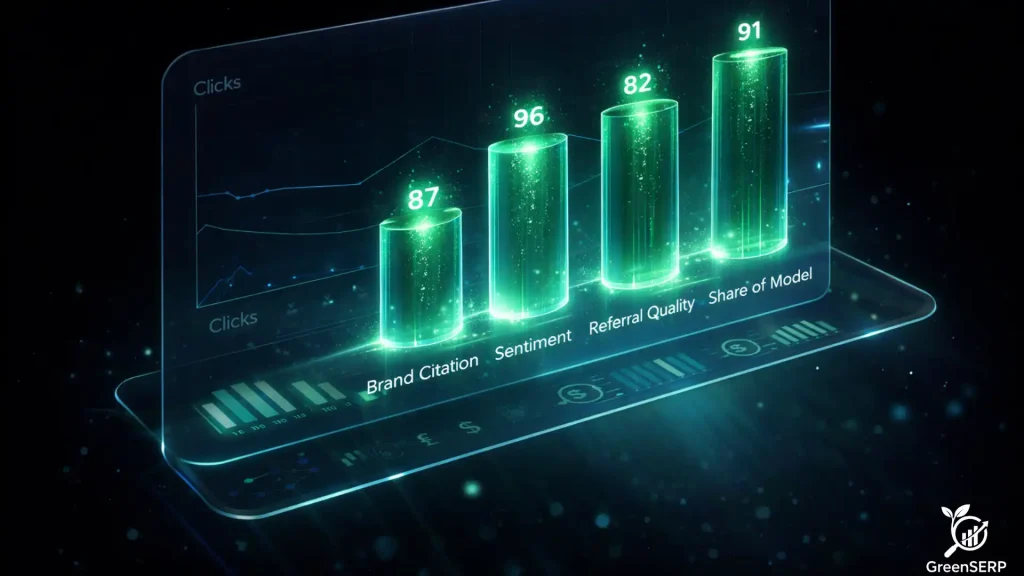
To measure success in an AI-driven world, you need a new stack of Key Performance Indicators (KPIs). This stack prefers brand visibility, trust, and quality over raw volume.
This new stack includes:
- Brand Citation Volume
- Emotion Analysis
- Referral Conversion Rate
- Share of Model (SoM)
By tracking these four areas, you can provide a more accurate picture of how organic search contributes to business growth.
Metric 1: Brand Citation and Presence
In the AI mode of search, a citation is as valuable as a click. A citation occurs when an AI model mentions your brand or links to your site as a source of its information.
How to track brand citations:
1. Manual Audits: Search for your primary keywords and see if your brand appears in the AI overview.
2. Tool-Based Tracking: Use modern SEO platforms that specifically track “AI Overviews” or “SGE” visibility.
3. Impression Data: Look for high impressions in Google Search Console paired with low clicks. This often indicates your content is being used to power an answer.
You should aim for a high “Citation Rate.” This is the percentage of AI-generated responses for your target keywords that include your brand as a source.
Metric 2: Emotion and Narrative Alignment
It is not enough to be mentioned. You must be mentioned in a positive or relevant context. AI models summarize the general agreement of the internet. If the agreement about your product is negative, the AI will tell the user that your product is poor.
Emotional analysis involves looking at the adjectives and descriptions the AI uses when talking about your brand. Are you described as “affordable” or “cheap”? Is your service “reliable” or “basic”?
To improve this metric, focus on your reputation across the web. AI models pull from reviews, forums, and social media. Ensuring your brand has a positive presence on third-party sites is now an important part of SEO.
Metric 3: Referral Traffic Quality Over Quantity
Since AI satisfies top-of-funnel queries, the traffic that does reach your site is usually high-intent. You must shift your focus to the conversion rate of this traffic.
Compare your “Post-AI” traffic to your “Pre-AI” traffic. You will likely see:
- Higher time on page.
- Lower bounce rates.
- Higher lead-to-click ratios.
If your sessions drop by 20% but your leads remain the same, your SEO is actually more efficient. You are filtering out the “window shoppers” and attracting only the serious buyers.
Metric 4: Share of Model (SoM)
Share of Model is the generative AI equivalent of Share of Voice. It measures how often your brand is recommended by LLMs (Large Language Models) compared to your competitors.
To calculate this, you can use a prompt-based testing method:
1. Ask a tool like ChatGPT or Claude for recommendations in your niche (e.g., “What are the best CRM tools for small businesses?”).
2. Run this prompt 50 times across different accounts or locations.
3. Calculate the percentage of times your brand is mentioned.
This metric tells you how much the AI “trusts” your brand. Increasing your SoM requires consistent, authoritative content and strong backlinks from high-trust domains.
Adjusting Your Content Strategy for Generative Search
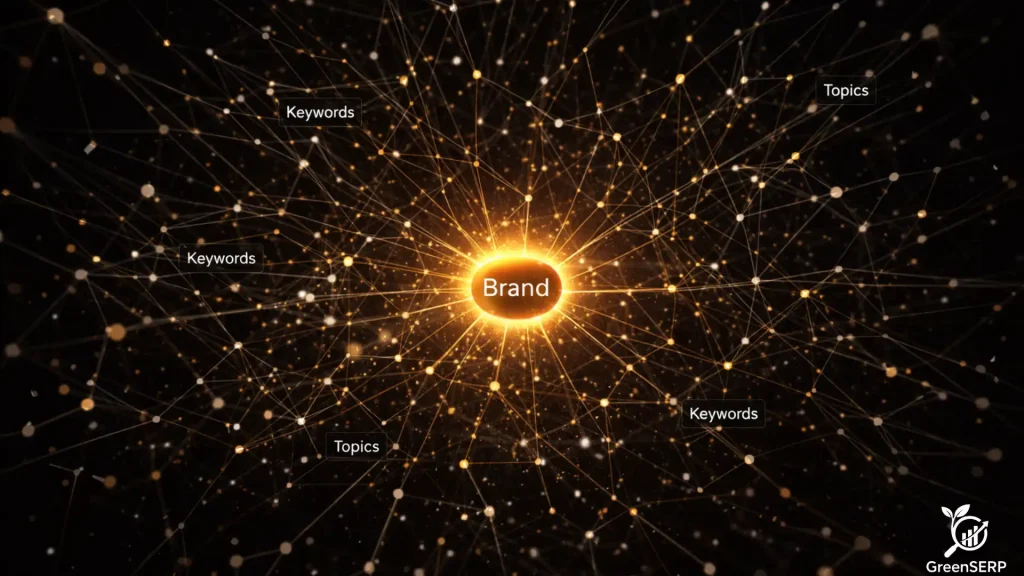
Content strategy must move away from “keyword stuffing” and toward “entity authority.” AI models don’t just look for words; they look for relationships between concepts.
To perform better in AI search, follow these guidelines:
- Be Direct: Put the most important information at the top of the page. AI models favor content that is easy to process .
- Use Structured Data: Schema markup helps engines auto-detect the context of your content.
- Answer Specific Questions: Use an FAQ format to address common user pain points.
- Provide Unique Data: Original research and case studies are easier for AI to mimic and more likely to be cited as a source.
Stop writing long introductions. Users and AI models both want to get to the point quickly.
Practical Checklist for Modern SEO Reporting
Use this checklist to update your monthly SEO reports for your team or clients:
- Track AI Snapshot Presence: What percentage of our top 50 keywords trigger an AI response? Are we in it?
- Monitor Branded Search Volume: Is the number of people searching specifically for our brand name increasing?
- Analyze Referral Quality: What is the conversion rate of traffic coming from AI-driven search engines (like Perplexity or Bing)?
- Audit Top-of-Funnel Content: Identify pages with high impression loss and determine if they should be repurposed into bottom-of-funnel assets.
- Review Emotion Trends: Use a tool to scan AI summaries for brand-related adjectives once a month.
- Check Schema Health: Ensure all product, review, and article schema is valid and error-free.
The Role of Technical SEO in AI Visibility
Technical SEO is not dead; it has simply changed its focus. In the past, technical SEO was about making sure a site could be indexed. Today, it is about making sure a site can be understood by a machine.
Crawlability is still important, but “readability” for LLMs is the new challenge. This includes:
- Relevant HTML: Using tags like `<article>`, `<section>`, and `<aside>` correctly.
- Fast Load Times: AI-powered crawlers have limited resources; the faster they can read your site, the better.
- API Availability: In some cases, providing an API or a structured feed of your data can help AI models access your information more accurately.
When the system’s auto-detect logic runs, it looks for clear signals. If your technical foundation is messy, the engine will skip your content in favor of a cleaner source.
Future-Proofing Your Marketing Measurement
Organic search is not going away, but it is becoming more integrated into the broader marketing mix. You can no longer look at SEO in a vacuum.
As AI continues to reduce clicks, the most successful brands will be those that prefer brand building. If people know your brand, they will search for you by name. If AI models trust your brand, they will recommend you to their users.
Focus on creating the best possible resources for your audience. Measure the impact through brand mentions, customer trust, and final conversions. The click is just one part of the journey. In the AI era, the destination is the reputation you build across the entire digital ecosystem.
By adopting the new KPI stack, you can stop chasing ghost traffic and start building a sustainable organic presence that grows in any environment.
CONCLUSION
SEO isn’t broken. Your measurement is.
AI Mode has turned clicks an incomplete metric. When users get answers directly in search results, traditional analytics can’t capture your true impact. You’re being seen, cited, and trusted, but your dashboard shows failure.
The new KPI stack fixes this gap:
- Brand Citations show where AI models reference you as a source
- Sentiment Alignment reveals how you’re being described
- Conversion Quality proves that fewer, better visitors drive results
- Share of Model measures your competitive position in AI recommendations
These metrics don’t replace traditional SEO tracking, rather complete it. Together, they tell the full story of how organic search builds authority, influences decisions, and drives business outcomes in an AI-first world.
Your next move:
Audit your AI overview presence this week. Add citation tracking to your reports. Calculate your baseline Share of Model. Educate stakeholders before they cut budgets based on incomplete data.
The brands winning in AI search aren’t getting more clicks, they’re getting more influence. Start measuring what actually matters, or watch your competitors claim the authority that should be yours.
Stop defending declining traffic. Start proving growing influence.
Monitoring these new KPIs requires a mix of traditional and AI-assisted analytics. If you are just starting out, start with this list of free AI analysis tools before upgrading to enterprise suites.