

Does this sound familiar? You’ve spent hours crafting the perfect blog post. You nailed the keyword density, optimized the meta tags, and hit publish with high hopes. But the post has vanished into page 10 of the search results, never to be seen again.
It is incredibly frustrating to pour resources into content that doesn’t perform. But for many content marketers and SEOs, this is a daily reality. The problem usually isn’t the quality of your writing; it’s the structure of your site.
Here is the hard truth, the era of keyword sniping and targeting individual keywords in isolation is fading fast. Search engines like Google have evolved. They no longer just scan for matching words; they are looking for semantic authority.
They want to know that you are an expert on a broad subject, not just a lucky guesser on a single phrase. When your content is scattered across your blog without connection, you are essentially competing against yourself.
Isolated posts struggle to gain traction because they lack the contextual support to signal authority to search algorithms.
This is where the concept of Topic Cluster comes in as the gold standard for modern site architecture. By organizing your content into deliberate, interconnected hubs, you turn isolated articles into a powerful ecosystem that dominates search results.
However, simply writing more content isn’t the answer. Truly understanding the Topic Cluster is the essential first step to building a Topic Cluster Content Strategy that actually drives traffic. Let’s dive in.
What is a Topic Cluster? (Definitions & Basics)
If you are new to SEO, you might be asking, “What is a Topic Cluster?”
Don’t let the technical name scare you. The concept is actually very simple.
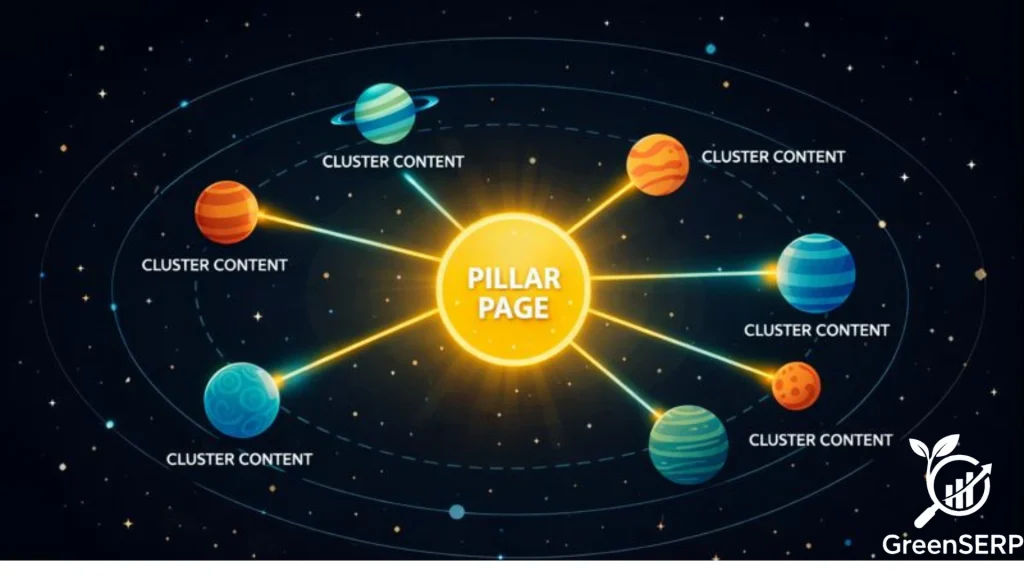
The Topic Cluster is a group of interlinked pages built around a central pillar page. Instead of writing about random keywords, you write about one main subject and link all related articles together.
Think about things that come in clusters in the natural world, like a bunch of grapes. A single grape is small and easy to overlook. However, a full bunch is heavy, substantial, and hard to miss.
Your website content works the same way. When you publish a blog post, it is like a single grape. It might be tasty, but it doesn’t look like much on its own. But when you connect that post to ten other related posts, you create a bunch of content. This signals to Google that you have a lot of authority on that subject.
The Three Components
To build this structure, you need three specific parts. If you are missing one, the cluster won’t work.
The Pillar Page:
This is your main hub. It is a long, broad guide that covers a general topic like “Digital Marketing“. It introduces the subject but leaves the specific details for the other pages.
Cluster Content:
These are your supporting blog posts. They dive deep into specific questions or sub-topics like “How to use Tiktok for Business”. Collectively, these pages form a Subject Cluster i.e “Digital Marketing”.
Hyperlinks:
This is the glue. You must link your pillar page to your cluster pages, and link your cluster pages back to the pillar. This strategy, known as Topic Based Clustering.It creates a web of connections that search engines can easily follow.
Terminology Check
As you research this strategy, you might see different names for it. Don’t get confused because the Topic Cluster Meaning is the same regardless of the label.
Because this strategy is used worldwide, you might even see international search terms. For example, marketers in Indonesia search for “Topic Cluster Adalah. Whether you call it a content hub, or a topic cluster, the goal is always the same: organizing your content to help you rank higher.

Topic Clusters and Pillar Pages: The Architecture
The Perfect Relationship
You cannot build a cluster without a pillar, and a pillar is useless without a cluster. They are a team.
Many people make the mistake of treating them as separate tasks. However creating Topic Clusters and Pillar Pages is a unified process.
Think of it like building a house. The pillar page is the foundation and the frame. The cluster content is the wiring, the plumbing, and the furniture. You need all to make the house livable.
Visualizing the Structure
It helps to see this strategy visually. If you were to draw a Topic Cluster Diagram or a Topic Cluster Map, it would look like a wheel.
The Hub: Your pillar page sits in the exact center.
The Spokes: Your links reach out from the center.
The Rim: Your cluster pages sit at the end of the spokes, all connected back to the middle.
When you zoom out, you might see several of these wheels on your website. One wheel covers “Marketing,” another covers “Sales,” and a third covers “Customer Support.”
A Group of clusters forms your site architecture also known as content constellation. This tells Google exactly how your website is organized.
Why are Topic Clusters Important?
You might be thinking, this sounds like a lot of work. Is it worth it?”
The answer is yes. Here is why Topic Clusters in SEO are so powerful:
Authority:
When you link many pages together, you pool their strength. If one page ranks well, it passes that authority to the others.
User Experience:
Readers love organization. It is easier to read a guide and click a link to learn more than to search your site for a related article.
Clean Structure:
This model helps you organize your URLs. Topic Clusters Page refers to keeping your links logical. Instead of a messy website, you get clean paths like website.com/topic/sub-topic. This makes it easier for search engines to crawl your site and index your content.

How to Build Topic Clusters (Strategy & Execution)
Building a cluster isn’t complicated, but it does require a plan. You cannot just start writing and hope it connects later. Follow these three steps to build a structure that ranks.
Step 1: Topic Discovery
First, you need to find the right Topics for Clustering.
Don’t start by looking for specific questions like “how to fix a leaky faucet.” Instead, look for the big themes. Ask yourself: “What do I want my business to be known for?”
If you are a plumber, your main topic might be “Plumbing Maintenance.” If you sell coffee, it might be “Brewing Methods.”
This is the core of a Topic Cluster Strategy in SEO. You need to choose high-value keywords that are broad enough to support 10 to 20 sub-articles. If a topic is too narrow, you won’t have enough to write about. If it is too broad, you will never rank for it. Aim for the middle ground.
Step 2: Mapping Content
Once you have your main topic, you need to organize your ideas.
Open a spreadsheet. You can create a simple Topic Cluster Sheet or search online for a free[Topic Cluster Template..
List your main topic in one column. Then, list every blog post you have already written. Match your existing posts to the main topic.
This process helps with Topic Cluster Visualization. When you see everything laid out on a sheet, you will spot the gaps immediately. You might realize, “I have a main page about Coffee, but I never wrote an article about Grinders.” Now you know exactly what to write next.
Step 3: Implementation
Now it is time to write. The best way to Build Topic Clusters is to start with the pillar page first.
Think of it like a tree. You need to grow the trunk ,“the pillar” before you can grow the branches and the cluster content. Write the broad overview page. Then, write the specific blog posts and link them back to the pillar.
Here are a few Topic Cluster Examples to help you picture it:
A Fitness Website:
- Pillar: The Ultimate Guide to Weight Loss.
- Cluster Content: Best Keto Recipes, Cardio vs. Weightlifting, How to Count Calories.
A Software Company (SaaS):
- Pillar: Email Marketing 101.
- Cluster Content: How to Write Subject Lines, Best Time to Send Emails, A/B Testing Guide.
By following this order, you ensure every piece of content has a home.

AI & Advanced Algorithms (The Technical Side)
The Evolution of Tech
In the past, creating clusters was a manual job. You had to look at a list of thousands of keywords and sort them into groups by hand. It was like trying to organize a library full of books without a catalog system. It took forever.
Today, we have better tools. We use Topic Clustering Algorithms to do the heavy lifting. These are computer programs designed to sort information instantly. They look at your list of keywords and find the connections that a human might miss.
Machine Learning Integration
This technology has become much smarter because of Topic Clustering Machine Learning.
Instead of just following basic rules, these programs actually learn from the data. Imagine a new employee who gets better at their job every single day. That is how machine learning works. It reads millions of web pages to understand how topics relate to one another.
This process is often called Topic Model Cluster Analysis. It sounds technical, but think of it like a chef tasting a soup. The chef can identify every distinct ingredient and how they blend together. The software does the same thing with words. It analyzes the “ingredients” of your content to group them perfectly.
The Role of LLMs (Large Language Models)
The biggest game changer recently is Topic Clustering LLM technology. This is the same “brain” behind tools like ChatGPT.
Topic Clustering Using LLM is different from older methods. Older tools just matched exact words. If you wrote “running shoes” and “sneakers,” an old tool might not know they are the same thing.
However, LLMs use Topic Clustering NLP (Natural Language Processing). This means the computer understands human language and context. It knows that “running shoes,” “sneakers,” and “trainers” all belong in the same group.
Using Topic Cluster AI saves you incredible amounts of time. You can feed it a messy list of ideas, and it will return a clean, organized map in seconds. It allows you to focus on writing great content while the AI handles the organization.

Tools of the Trade (Generators & Software)
Automating the Process
You know the strategy. You understand the technology. Now, you need the right tools to build it.
Trying to build clusters in your head is overwhelming. It is like trying to solve a Rubik’s Cube blindfolded. Fortunately, you can use a Topic Cluster Generator to solve the puzzle for you.
These tools are essential for modern marketers. The newest wave of software, the AI Topic Cluster Tool Generator., takes automation to the next level. You simply type in one broad keyword, and the tool spits out a complete content plan with pillar pages and supporting articles already mapped out.
Tool Options
So, which tools should you use?
If you prefer manual control, you can try Topic Cluster Using Ahrefs or Semrush. These are powerful industry standards. They give you all the data you need, but you still have to do some of the sorting yourself. It is like driving a manual transmission car, you have total control, but it takes more effort.
If you want speed, look for a dedicated Topic Clusters Tool. Many new platforms are built specifically for this purpose. They are designed to visualize your site and spot opportunities automatically.
Budgets are tight for everyone, so you might be looking for a Free Topic Cluster Too. While paid tools offer more features, there are free options available. AnswerThePublic or Google’s own “People Also Ask” feature are great places to start. They won’t build the map for you, but they will give you the raw materials you need to get started.

Measuring Success & Avoiding Pitfalls
Analytics
Once you hit publish, the work isn’t finished. You need to verify that your plan is actually working.
You wouldn’t drive a car without checking the gas gauge. In the same way, you shouldn’t run a website without checking your data.
This process is called Topic Cluster Analysis. It is like a health checkup for your content. You need to see which pages are bringing in traffic and which ones are not.
As you look at your data, you might encounter a fancy term, “Topic Cluster Prominence Percentile”.
It sounds complicated, but the concept is simple. It measures how much of the conversation you own. Imagine a room full of people talking about “coffee.” If you are the only one answering questions, you are the most prominent person there.
This metric tells you if you are the leading voice on a topic compared to your competitors.
Troubleshooting
Even with a solid plan, things can go wrong. It is important to watch out for common SEO Topic Clustering Mistakes.
The biggest mistake is competing with yourself. This happens when your specific Topic Cluster Blog posts cover the exact same ground as your pillar page.
If two pages on your site answer the same question, Google gets confused. It doesn’t know which one to show, so it often shows neither. Keep your boundaries clear. Let the pillar page handle the “What” and the “Why,” and let the cluster pages handle the “How.”
Conclusion
We have covered a lot of ground, from the basic definitions to advanced AI tools. If there is one thing you should take away from this guide, it is that the old way of doing SEO chasing random keywords is over.
Understanding the Topic Cluster Meaning is the first step toward building a website that Google respects. It is no longer enough to write good content; you must organize that content so it makes sense. By grouping your ideas, you prove to search engines that you are a true expert in your field.
Remember, this is a long-term game. A Topic Cluster Strategy is an investment. It might take some time to reorganize your site and write the necessary pillar pages, but the payoff is worth it. You will build a sustainable flow of traffic that doesn’t disappear the moment you stop publishing.
So, do not let this information sit unused. Start creating Topic Clusters and Pillar Pages today. Look at your existing content, find the connections, and start building your map.
Ready to get started?
Open a blank spreadsheet or grab a Topic Cluster Methodology template right now. Pick one broad topic you want to own, and list five sub-topics you can write about this week. The best time to organize your content was yesterday, the second best time is now.